Soft-Shell Eggs

Soft-shell eggs, also known as thin-shelled eggs or eggs with fragile shells, are eggs that have a shell that is not fully formed or is thinner than usual. These eggs can break easily or completely fall apart in your hands.

There are several reasons why a chicken may lay a soft-shell egg. One of the most common reasons is a lack of calcium in the chicken's diet. Calcium is an essential mineral that is necessary for the formation of strong eggshells.

Other possible causes of soft-shell eggs include stress, disease, and genetics. Chickens that are under stress or have an illness may produce eggs with weaker shells. Some breeds of chickens are more prone to laying soft-shell eggs than others.

If you have a backyard chicken coop and are experiencing issues with soft-shell eggs, there are several steps you can take to help your chickens produce stronger shells. One of the most important things you can do is make sure your chickens are getting enough calcium in their diet. This can be achieved by feeding them a diet that includes plenty of calcium-rich foods, such as oyster shells, crushed eggshells, and calcium supplements.

You can also help reduce stress in your chickens by providing them with a clean and comfortable environment, plenty of fresh water, and a balanced diet. Regular veterinary check-ups can also help identify and treat any health issues that may be affecting your chickens.

Moulting Chickens - Why do my hens look naked?!

Our girls have been going through a pretty heavy moult over the winter months, they are just on the other end now with new pin feathers coming through!

Poultry moulting is a natural process that occurs in birds where they shed their feathers and grow new ones. This process is important for the health of the birds, as it helps to keep their feathers in good condition and ensures that they are able to regulate their body temperature effectively.

What is a moult?

Moulting is a natural process that occurs in birds where they shed their old feathers and grow new ones. This process usually occurs once a year, but can happen more frequently depending on the age and health of the bird. During the moulting process, birds may stop laying eggs temporarily, as their bodies are diverting energy to growing new feathers.

The moulting process can last anywhere from a few weeks to a few months, depending on the species of bird and the individual bird's health. It is important to note that during this process, birds may experience some stress and discomfort, as they are shedding their feathers and growing new ones.

Why is moulting Important?

Moulting is important for the health of poultry because it helps to keep their feathers in good condition. Feathers are important for birds because they provide insulation, protect the skin, and help with flight. If a bird's feathers are damaged or worn out, it can lead to health problems such as hypothermia, sunburn, and infections.

In addition to the health benefits of moulting, the process can also help to increase egg production in poultry. When birds go through the moulting process, they stop laying eggs temporarily, but once they have grown their new feathers, they will often begin laying again. This can result in increased egg production and improved profitability for farmers.

How to manage a moult

If you are a farmer or backyard chicken keeper, it is important to be aware of the moulting process in your birds and to take steps to manage it properly. Here are some tips for managing poultry moulting:

  1. Provide a balanced diet: Birds need a balanced diet with adequate protein, vitamins, and minerals to support healthy feather growth.

  2. Ensure adequate lighting: Poultry require at least 14 hours of light per day to maintain egg production. During the moulting process, birds may require additional lighting to help them grow new feathers and resume laying.

  3. Keep birds comfortable: During the moulting process, birds may experience some discomfort and stress. To help minimize this, provide them with a clean, dry, and comfortable environment with plenty of space to move around.

  4. Monitor health: Keep a close eye on your birds' health during the moulting process. If you notice any signs of illness or abnormal behavior, consult with a veterinarian.

Moults are most common during autumn, and in my experience, it usually happens between late September, October and November, just before it gets really cold.  It can be quite frightening as one day they can seem fine and fully feathered and the next morning you are faced with a coop full of feathers!

Avian Influenza

Avian influenza, also known as bird flu, is a viral disease that primarily affects birds. There are many different strains of the virus, some of which are more dangerous than others.

Globally, AI has been seen to be a problem mostly in the developing, rather than western, world. However, whilst Defra and the Animal and Plant Health Agency do their best to keep the disease out, it is impossible to prevent it. It makes its way into the UK with migrating wild birds and can all-to-easily be transferred to domesticated birds. Whilst there are AI vaccines, these have their limitations and in the UK the vaccination of poultry and most captive birds against AI is not currently permitted.

During the autumn of 2021 there were multiple findings of the highly pathogenic strain of HPA1 H5N1 in wild birds and following its confirmation in poultry, the UK was declared no longer free from AI under the World Organisation for Animal Health (OIE) rules. This led to an Avian Influenza Prevention Zone (APIZ) being declared across Great Britain on November 3 requiring all bird keepers by law to take a range of biosecurity precautions. It also brought in a ban on all gatherings. A further requirement was imposed from November 29, making housing mandatory.

Advice and what to do:

Bird flu (also called avian influenza) is a notifiable, infectious disease that affects both wild and kept poultry. The disease is taken very seriously as it's devastating to birds, spreads very fast and whilst some strains have the potential to jump from birds to humans, this is very rare.

The UK's devolved administrations may decide to declare an Avian Influenza Prevention Zone (AIPZ), either regionally, or across the whole of the UK to help reduce the risk of the disease spreading.

  • Bird flu is a notifiable animal disease. If you suspect any type of avian influenza in poultry or captive birds you must report it immediately by calling the Defra Rural Services Helpline on: 03000 200 301. In Wales, contact: 0300 303 8268.

  • If you find dead wild waterfowl (swans, geese or ducks) or other dead wild birds, such as gulls or birds of prey, you should report them to the Defra helpline (03459 33 55 77 - please select option 7). You can also report dead wild birds to defra on their website. Don't touch or pick up any dead or visibly sick birds that you find.

All bird keepers (whether you have pet birds, commercial flocks or just a few birds in a backyard flock) must keep a close watch on them for signs of disease and maintain good biosecurity at all times. This is especially relevant if your birds are in a Higher Risk Area (HRA). If you have any concerns about the health of your birds, seek prompt  advice from your vet.

You should register your poultry, even if only kept as pets, so Defra can contact you during an outbreak. This is a legal requirement if you have 50 or more birds. Poultry includes chickens, ducks, turkeys, geese, pigeon (bred for meat), partridge, quail, guinea fowl and pheasants.

Keepers can check where disease control zones and AIPZs are located in GB and if they are in a zone on the animal and plant health ahgency’s map.

To receive immediate notification of new cases and updated zones in GB please sign up to the APHA’s Animal Disease alert subscription service further details can be found on the link below

Keeping Birds:

Preventing the spread of avian influenza involves taking several precautions, including practicing good hygiene, avoiding contact with sick birds or their faeces, and cooking poultry products thoroughly. It's a legal requirement for all bird keepers (whether they have commercial flocks, a few birds in a backyard flock or pet birds) to follow strict biosecurity measures. Keepers with more than 500 birds need to restrict access for non-essential people on their sites, workers need to change clothing and footwear before entering bird enclosures and site vehicles need to be cleaned and disinfected regularly.

The prevention zone means bird keepers must:

  • Ensure the areas where birds are kept are unattractive to wild birds, for example by netting ponds, and by removing wild bird food sources.

  • Feed and water kept indoors or enclosed areas to discourage wild birds.

  • Minimise movement in and out of bird enclosures.

  • Clean and disinfect footwear and keep areas where birds live clean and tidy.

  • Reduce any existing contamination by cleansing and disinfecting concrete areas, and fencing off wet or boggy areas.

Avian Influenza can be devastating to the poultry industry, we’re already seeing the knock-on effects of the culling last year with limited egg availability in the shops!

The hens are currently under a housing order put in place by the government, we’re hoping that this will be lifted shortly, last years housing order was in place for over 16 weeks, which meant all the eggs in the UK had to change their classification to ‘barn raised’. We’re hoping this doesn’t happen this time! We’re all keeping our fingers crossed that the hens will be out in the sunshine soon!

Egg Bound Hens; What To Do

In the 8 years of keeping chickens professionally, we’ve only ever come across an egg bound hen once. In this instance, and as a novice in this area, I went straight to the internet to see what other chicken keepers recommended I do to save the poor girl.

If left untreated, an egg bound hen could die, so it’s best to get in their quick and help her out as soon as you notice something isn’t right.

unsplash-image-DSgjjsjnvQQ.jpg

What is egg binding?

‘Egg bound’ means she has an egg stuck somewhere in her oviduct. The usual place is between the uterus and the cloaca. Sometimes you can even see it from the cloaca/vent. When the egg is ready to pass, the cloaca seals shut the intestinal opening so that eggs don’t get covered in poop. If the hen cannot poop within twenty-four to forty-eight hours, she will likely die. Other effects seen from egg binding are vent prolapse – where the vent hangs out of the rear end and, in severe untreated cases, egg yolk peritonitis which can quickly kill a hen from infection.

What’s the reason behind it?

There are multiple things that can cause egg binding. Some are manageable, others not so much.

  • Passing large or odd-shaped eggs. The oviduct can only stretch so far, and a large or misshapen egg can get stuck.

  • Malfunction in the reproductive system. Some hens are prone to problems and will lay odd or parchment eggs regularly – genetic issues.

  • Double yolk eggs. These are larger than the usual egg and can cause problems.

  • Malnutrition – poor diet low in necessary vitamins, minerals, and protein.

  • Sedentary life or obesity – muscles become weak from lack of activity or being overweight.

  • Premature laying – hens that are forced to lay before they are fully developed often develop binding.

  • Elderly chickens – weak muscles and inactivity.

  • Egg retention – if insufficient nest boxes are available, a hen will sometimes ‘hold’ her egg.

  • Underlying reproductive tract infection. Severe infestation of internal parasites.

As you can already see, some of these are readily preventable by good nutrition and attention to the health and welfare of your hens.

How do you know when a hen is egg-bound? Truly, sometimes you don’t. As we know, hens are secretive about any illness or problems. If she can pass the egg herself, you may not even realize she had a problem.

Common symptoms to look for include:

  • Decreased appetite and drinking.

  • Lethargic, sitting around, fluffed up.

  • ‘looks sick,’ depressed.

  • Shaky wings.

  • She walks like a penguin – she will periodically stop walking and try to squat.

  • Abdominal straining – you can see the cloaca (vent) straining to expel something.

  • Tail pumping – her tail will pump up and down to expel the egg.

You can probably apply the first three groups of symptoms to any chicken that is sick with anything. They will usually set off by themselves in a quiet spot. She will fluff the feathers out, and she may have her eyes closed like she’s taking a nap. These signs always bear watching.

How to treat your hen

First, you need to check if she actually is egg bound. Using a latex glove and some vaseline, very gently insert your finger into the vent. Push your finger straight back about two inches or so – you should be able to feel the egg. If you cannot feel an egg – she’s not egg bound.

Prepare a warm water bath with Epsom salts (1 cup ES/1 gallon of water). It needs to be deep enough for your hen to sit to a depth of about three to four inches.

Before you put her in the bath, give her some calcium. A calcium tablet will work great. Make sure you powder it or break it into tiny pieces so the hen can swallow it. Calcium helps to improve the strength of the contractions and helps to expel the egg.

Gently put your hen into the water. She may struggle for a bit, but they usually settle down after a couple of minutes – I think it feels good for them!

She will need to sit in the bath for about fifteen to twenty minutes. When you take her out, towel her off, so she gets dry – a hairdryer will do the trick nicely if she tolerates the noise.

Before doing anything else, place your hen in a quiet, dark, and warm space. The goal is to allow her to lay her egg without any extensive intervention from you or a veterinarian.

After her ‘salon treatment’, put her in a darkened crate with some water and food to drink. If her vent area is swollen, apply some Preparation H, it will help to reduce the swelling. You may need to repeat this treatment three or four times over several hours to try to move the egg along. If, despite your best efforts, she does not pass the egg, your treatment options are getting narrower.

You should seek the services of a veterinarian if you can afford them. If not – the alternative is to remove the egg yourself.

This is not without hazard to your hen. This course of action should be taken as a ‘last resort. We do not advise you to do this unless you have no other choices.

If you can see the egg at the vent, gently make a hole in it large enough to be able to suck the contents out with a syringe (please, no needle!). Once you have the contents out, gently pull on the shell in an attempt to bring it out intact, but if it breaks apart, make sure you have all the pieces.

If you cannot see the egg but can feel it, try to lubricate the vent and cloaca well and try manual manipulation. Sometimes the egg will move, sometimes it breaks. If it breaks, you will have to remove all the shells manually. Any shell pieces left inside will cut and a-braid the interior of the oviduct, leaving the hen wide open to infection.

If you have successfully removed the egg, put her in a crate for a few hours until you know she is eating and drinking just fine. Also check her vent area for prolapse or excessive redness – if it looks red and sore, keep her separate from the flock for a bit longer. If the egg broke inside her, you would need to give her some antibiotics to prevent infection – this requires a veterinarian.

Hopefully you’ll never experience this yourselves, but if you do, I hope this helps you out as much as it helped me!

Hens and eggs

Why Choose Pasture Raised?

People always ask us; What’s the difference between pasture fed and free range?

Pasture raised basically means that the way we farm is different. We don’t have 1 huge shed filled with thousands of chickens, which nowadays is the norm when it comes to raising chickens for egg production. We have a few smaller coops that house 150 in each. This allows us to keep our husbandry to the highest level and make sure all our hens are happy and healthy.

We take great pride in the welfare and environment of our hens. All our laying hens live in small mobile coops with constant access to our pasture. We regularly move the runs to give them new areas to feed and display the hens natural behaviours. The hens eat only natural organic food and a mixture of grasses and herbs as well as any delicious grubs they can dig up! They are put to bed in their hen sheds at night to protect them from any predators, where they roost on elevated perches. We nearly always have cockerels with the flocks as we find the hens like the added security that they provide and it gives the flock much more of a natural family feel. A happy and well-nourished flock equates to great eggs.

Contrary to popular belief, chickens are actually omnivores, not vegetarians. As the chickens are able to forage for some real animal protein. Insects, worms, flies. They can also eat as much grass as they like, not to mention breathe fresh air and feel the sun on their backs (when it’s available). All contributing to the living conditions of our happy hens. Although we don’t use our hens for meat, we do use our surplus cockerels. A huge bonus of pasture raised chickens is the higher quality meat. There’s research that shows that an animal that is raised on a pasture based system produce meat that is lower in total fats and calories! Their meat is also higher in good fats such as Omega 3, they’re more concentrated with antioxidants such as vitamin E and C with higher levels of disease-fighting substances like CLA (Conjugated Linoleic Acid) thought to help prevent cancer. Not to mention the improved taste!

We take our cockerels to at least 6 months old on the pasture before taking them to the abattoir. They live the best possible life, living naturally and free ranging all day before giving us the opportunity to sell them as meat to create more income to help sustain their breed. You can buy our cockerels ready processed and frozen on our website. Why not give it a try and let us know what you think!

Higher Oak Farm; Where We Are Now

So over the past year our farm has changed tremendously.

January 2020 we started the year off with a barn, a temporary house 4 X ‘50’ houses, 7 breeding runs, a poly-tunnel and an incubator that could fit 60 eggs in. My how we’ve grown! Our smallholding in Lymm now consists of a barn, a temporary house, 2 laying houses, each housing 150 birds in, we’ve got 6 of our ‘50’ houses, 2 of our ‘100’ houses, 7 breeding runs, 2 brooding sheds, a holding shed, a poly-tunnel, 2 new incubators pushing our capacity up to 1300 eggs at a time, a wildflower meadow, 10 beehives, a shepherds hut and a dog!

IMG_5229 copy.jpg

This past year has been the weirdest one for all of us. Never in my life did I think i’d see a pandemic, let alone run a business during one. Luckily for us, our business was one of few that actually thrived during the pandemic. People stockpiling all sorts of stuff meant that shops were looking sparse, pushing people to change the way they shopped, sourcing more stuff locally, learning about food miles and what this means to our planet and all in all becoming a little bit more self sufficient.

Higher Oak Farm 0065.jpg

At one point last summer we had waiting lists of weeks for both our eating eggs and our hens. People were spending more time at home, in their garden; revamping chicken houses or just building a run from scratch. It was honestly, madness - in THE best possible way! The selling of our eggs and our birds continued right through the summer into the beginning of Autumn. At this point, we opened ‘The Shepherd’s Hut’.

Photo 24-11-2020, 11 45 30 am (1).jpg

We opened the hut for the first time on the 26th November 2020. In the weeks running up to our opening, we had so many people speculating what it was, and what it was going to be used for. Once we opened our doors, it gave so many more local people the opportunity to learn about us and what we do on our farm. We took this opportunity to educate people on the poultry industry and the advantages of buying local, naturally farmed eggs and produce. We started putting some of our own baked treats and and they were flying off the shelves. It was almost impossible to keep it full!

Shepherds Hut Goodies

We genuinely couldn’t believe the reaction that we got from local residents and people from further afield. Hearing such positive feedback only spurred us on more. We sourced local produce like our Apple juice and even started to make jams using local produce too.

After a few months, we deiced the only logical next step was to put a coffee machine in the hut, who doesn’t love a coffee or a cuppa with a slice of brownie? You’d be mad if you didn’t!

I honestly can’t believe how much our business has changed in the past 12 months, the support that we’re getting of local Lymm residents and the time it takes to feed chickens! We’re super excited to see where we’ll be this time next year.

Is Your Hen Lonely?

If you’ve got 1 hen on it’s own, then chances are it’s lonely!

Chickens have a social order. Each chicken takes on an individual role within the flock which is the basis for the pecking order. This starts from the chick hatching all the way through to adult-hood. It’s what keep the peace within the coop.

The cockerel or the top hen looks out for the flock. They keep and eye out and sound out when there’s a predator near the flock. They are also the first to eat and drink before any other member of the flock. You’ll often find 2 or 3 hens grouped together on a daily basis. A lone chicken has no emotional or physical support and they become bored and lonely which can cause stress and can affect their egg production.

Having one lone hen makes them a great prey for predators. It can also effect the during the winter. The hens cuddle up to each other during the colder months to keep warm.

So whats the magic number?

The smallest ideal flock size is three hens for not only egg production but also in case one of them becomes sick or dies, it always leaves two together.

If you find yourself with only one chicken, what should you do?

The best option is to get some flock mates ASAP. Until then, you will need to find adequate protection for your hen, some people opt to bring them in the house, but a predator proof cage works just as well. Plan some entertainment for your chicken by putting new things to eat in the cage or by moving it around to different areas.

How to introduce a new hen

When the happy day arrives that you have found a couple of flock mates for your chicken, it is best to follow some rules to keep the bullying down in the coop.

First, it is best to quarantine the hens for a few days and/or have it checked by your vet to make sure they are healthy before introducing them to your coop.

Then place them in a smaller pen inside of the coop so they can get to know each other before they can physically peck at each other.

Once they are happy enough in each others company, you can let the new hen out and there should be minimal issues and you’ll have a happy flock!

Scaly Leg Mites

We took in 2 hens that a friend of ours was looking after to keep his single hen company. The hens were recently brought back to us, but with Scaly Leg!

images.jpg

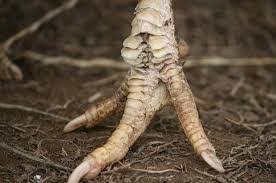
Scaly Leg is an infestation caused by a small parasitic mite known as Cnemidocoptes Mutans. This tiny mite lives in the ground or sometimes the floor of the henhouse in damp conditions. It then burrows under the scales of the bird's legs or feet, where it causes great discomfort. It may also infest other areas such as the comb or wattles of chickens.

It doesn't only affect poultry, any scaly-legged bird is susceptible e.g. small garden birds, and these birds can often carry the mite into your chicken run.

The mite causes a multiplication of the tissue cells and the secretion of a serum. The scales are raised, the legs become thickened and have a rough lumpy appearance, often showing what would appear to be a white growth on the leg.

The infection is easily recognised because of the raised scales although the mite are hard to see with the naked eye, they look like tiny white spherical creatures (approximately 0.25-0.5mm in diameter in the early stages).

Scaly Leg Mite is highly contagious and affects birds of all ages, although older birds and feathered leg breeds tend to be more susceptible. It is most common in flocks kept on bare earth, damp ground or in dry litter runs.

In the early stages it would appear to cause very little problem, but should it be neglected the birds lose condition, go lame and have difficulty in perching. If left untreated then further infections can occur and the bird could die.

Any treatment of a bad infestation will not be quick, it will require a number of weeks of constant treatment until finally the encrustations fall off and the scales return to normal. We use a spray that is made of natural materials that really works!

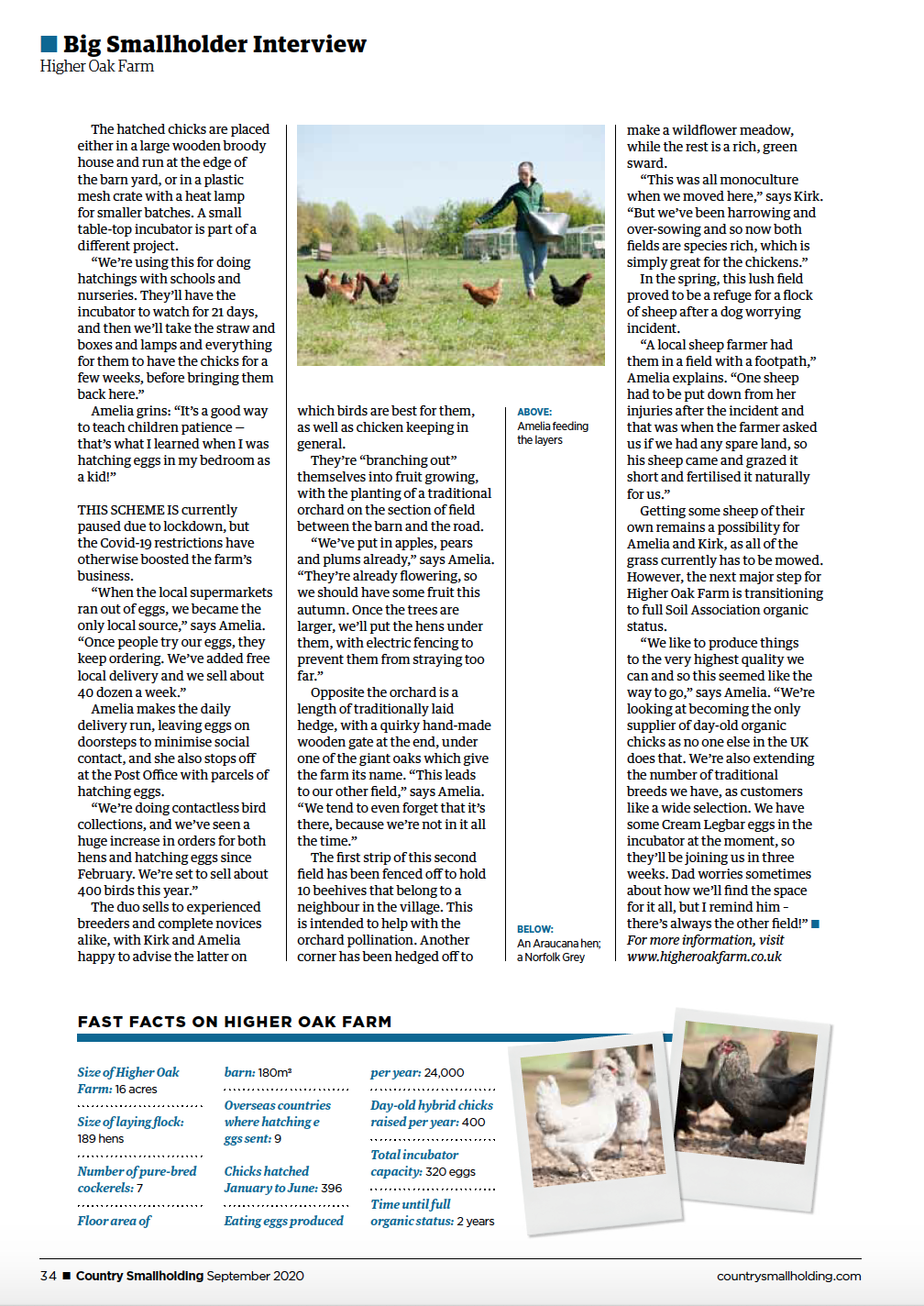
Country Smallholding - Big Smallholder Interview

A few months ago my dad and I were interviewed about the farm and how we came to be. Here’s the whole article for you to read!

Screenshot 2020-10-05 at 12.42.57.png
Screenshot 2020-10-05 at 12.43.10.png
Screenshot 2020-10-05 at 12.43.20.png

If you’re loving this article, then why not look at signing up to a monthly subscription?

My Hen Laid A Weird Egg..

If you’ve had hens before, you’ll know that occasionally your ladies can lay some weird looking eggs! This blog is to help you understand why your hens are producing abnormal eggs.

Double Yolkers.

These are such an amazing find! There’s nothing better than cracking open your egg to find 2 yolks. This can happen when an existing yolk combines with another and the shell forms around both. It’s a hens version of twins. Young pullets and older hens tend to lay these are their egg cycles are just beginning or coming to the end.

Double Yolker.png

Super Tiny Eggs.

Also known as wind, fairy or fart eggs, tiny eggs can be a sign that your hen has just started to lay or that something might be wrong with their production system if they keep laying them. If they are constant, ensure you speak to your vet.

You should always consider the age of the hen if you experience any of the below:

Thin Shelled Eggs

This is usually a sign that your hen needs a bit more calcium in their diet. You can add this in by providing them with Oyster Shell. The hen will then ingest as much as she needs.

Bumpy Eggs

These are abnormal for both young and older hens. This can be caused by excess Vitamin D or Vitamin C in the hens diet.

Very Large Eggs

These tend to be laid by hens coming to the end of their laying cycle.

Stress, Diet or Disease can cause the below abnormalities:

Shell-less or Thin Shelled-Eggs

These are normally due to stress, which causes the eggs to be laid before it’s been completely formed.

Wrinkled Eggs

These are funky looking and can be induced by rough handling of your hens, causing a second yolk to be prematurely released and bumping up against the egg, causing the wrinkles. Another factor that can cause wrinkling is a respiratory infection in the hens.

Eggs with Healed Cracks

These start with a break in the shell during formation but mend during the laying process. The hen experiencing stress during the calcification is the main culprit for this type of egg.

Egg In An Egg

This happens when an egg gets backed up and not laid in a timely manner. The egg actually goes through the last production stages twice. Extreme stress to your poor hen is probably the reason. She may need a spa day complete with a dust bath and mealworms to nibble on.

If you find that you’re experiencing any of the above and have tried to fix the issue but had no luck, make sure to contact your vet to make sure your lovely lady is ok!